



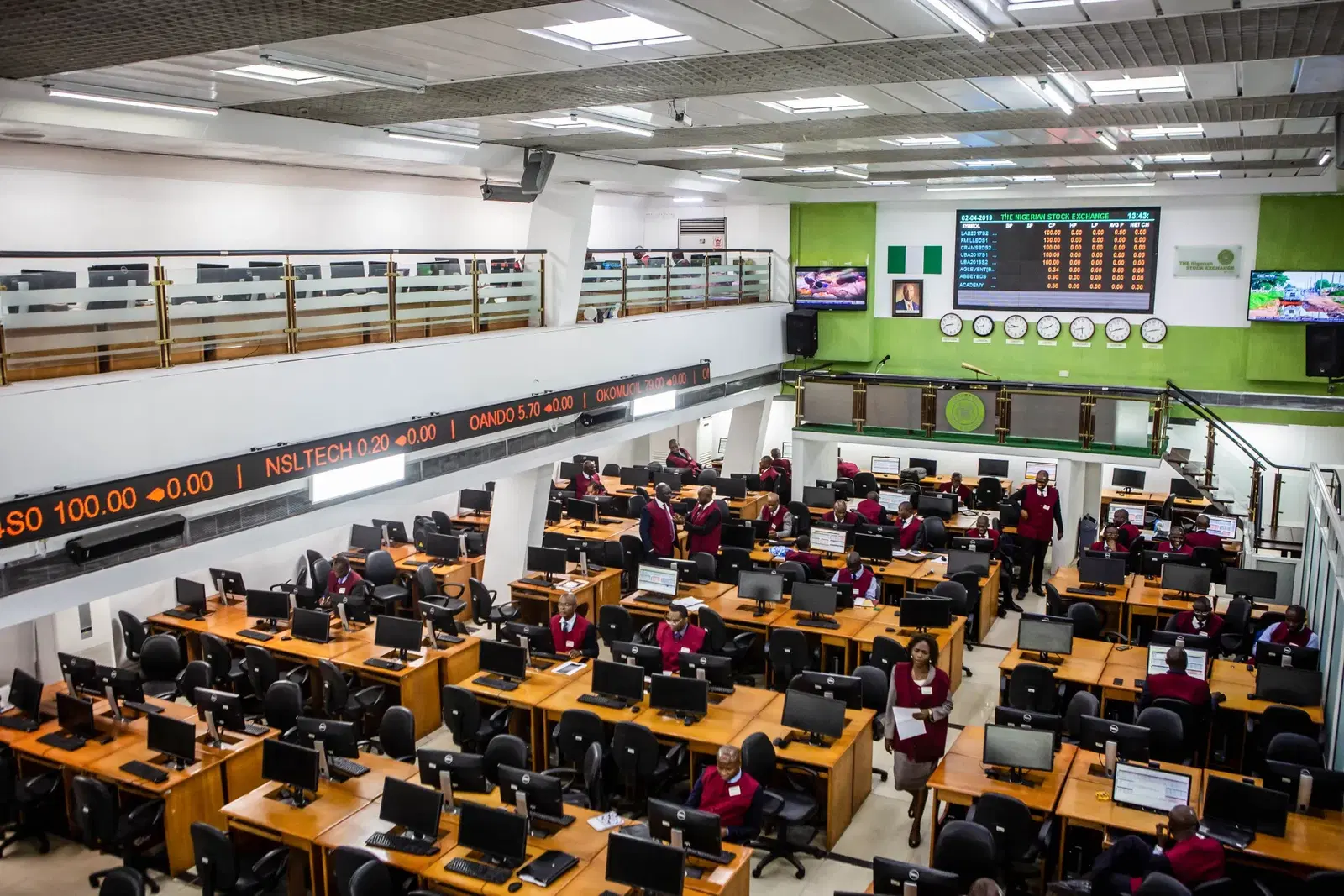
24 Companies Control 74.8% of Nigeria’s Stock Market Value
Twenty-four leading companies accounted for 74.8% of the total market capitalisation of Nigeria’s equities market as of August 17, 2026, highlighting the growing influence of large-cap stocks on the Nigerian Exchange (NGX).
The companies, drawn mainly from the banking, consumer goods, industrial goods and energy sectors, had a combined market value of N117.01 trillion.
Meanwhile, the overall market capitalisation of the NGX climbed to N156.517 trillion from N99.376 trillion at the end of 2025.
That represents a year-to-date increase of N57.141 trillion, or 57.5%.
The strong performance reflects a broad rally in Nigerian equities. However, analysts warn that the concentration of market value among a relatively small number of companies means movements in major stocks can have a significant effect on the overall market.
Dangote Cement overtakes MTN Nigeria
Dangote Cement emerged as the most capitalised company on the NGX after overtaking MTN Nigeria.
The development underlines the growing dominance of major industrial and consumer-facing companies in Nigeria’s stock market.
Also Read: FG Upgrades 4 Lagos Substations, Adds 360MW Transmission Capacity
Large-cap stocks have played a major role in driving the increase in the NGX’s total market value this year.
However, the strong performance of the headline index does not necessarily mean that every listed company has recorded similar gains.
Banks remain major players on NGX
The banking sector remains heavily represented among Nigeria’s most valuable listed companies.
First Holdco led the banking stocks with a market capitalisation of N6.37 trillion.
Zenith Bank followed with N5.04 trillion, while GTCO recorded N4.70 trillion.
Stanbic IBTC Holdings had a market capitalisation of N2.56 trillion, followed by United Bank for Africa (UBA) at N1.99 trillion.
Access Holdings and Fidelity Bank recorded N1.45 trillion and N1.38 trillion, respectively.
Ecobank Transnational Incorporated and Wema Bank had market capitalisations of N1.27 trillion and N1.16 trillion.
Analysts attributed the strong performance of banking stocks partly to improved investor sentiment following the sector’s recapitalisation exercise.
BUA Foods leads consumer goods stocks
BUA Foods emerged as the most capitalised company among the leading consumer goods stocks, with a market value of N13.69 trillion.
Presco followed with N2.40 trillion, while Nestle Nigeria recorded N2.22 trillion.
Nigerian Breweries and International Breweries ranked next with market capitalisations of N2.10 trillion and N1.79 trillion, respectively.
The consumer goods sector has benefited from expectations of better operating conditions.
However, businesses in the sector continue to face challenges from high production costs, inflation and weak consumer purchasing power.
Dangote Cement leads industrial stocks
Dangote Cement remained the dominant industrial stock, with a market capitalisation of N17.15 trillion.
BUA Cement followed with N13.69 trillion, while HBM Nigeria recorded N5.38 trillion.
The performance of these companies highlights the important role of large industrial stocks in the expansion of Nigeria’s overall equity market value.
Energy stocks record strong valuations
The energy sector also featured prominently among Nigeria’s most valuable stocks.
Seplat Energy and Aradel Holdings were reported at N6.72 trillion each in market capitalisation.
Geregu Power followed with N2.06 trillion, while Transcorp Power recorded N1.65 trillion.
The valuations reflect strong investor interest in Nigeria’s energy companies as the sector continues to attract attention from local and international investors.
Analysts split on NGX investment outlook
Analysts have maintained mixed views on the investment prospects of companies listed on the NGX.
Among 32 stocks reviewed by analysts, 17 received Buy or Strong Buy ratings, while 12 were rated Sell or Strong Sell. Three stocks received Neutral ratings.
The recommendations are based on factors including earnings prospects, valuations, business fundamentals and expected share-price performance.
Stocks receiving Buy or Strong Buy recommendations included Aradel Holdings, Access Holdings, Dangote Cement, Dangote Sugar, FCMB, GTCO, Guinness Nigeria, HBM Nigeria, Honeywell Flour Mills, Nigerian Breweries, Nestle Nigeria, UACN, Transcorp Corporation, UBA, Zenith Bank and Cadbury Nigeria.
Sell or Strong Sell ratings were assigned to stocks including BUA Cement, BUA Foods, Conoil, First Holdco, International Breweries, Julius Berger, Okomu Oil, Presco, PZ Cussons, Stanbic IBTC, TotalEnergies Marketing and Unilever Nigeria.
Fidelity Bank, Ecobank Transnational Incorporated and NASCON Allied Industries received Neutral ratings.
Biggest NGX gainers in 2026
Despite the dominance of large-cap companies, some mid- and small-cap stocks recorded the biggest year-to-date gains.
Zichis Agro Allied Industries was the strongest performer, gaining 1,744.22% to N18.35 per share.
SCOA Nigeria followed with a 365.49% gain to N33.05, while Infinity Trust Mortgage Bank rose 221.43% to N11.25.
Berger Paints Nigeria gained 207.50% to N147.60 per share, while Premier Paints increased by 204% to N30.40.
Other major gainers included First Holdco, which rose 198.51% to N140; Vitafoam Nigeria, up 153.04% to N194; and HBM Nigeria, which gained 149.25% to N334.
Some stocks decline despite market rally
The broader market rally did not benefit every listed company.
Sovereign Trust Insurance was the biggest loser, declining 50.39% to N1.89 per share.
Guinea Insurance fell 43.37% to N0.76, while Ellah Lakes declined 41.52% to N8.10.
SUNU Assurances Nigeria lost 39.64% to close at N3.32, while Austin Laz dropped 39.06% to N2.84.
Other notable decliners included Royal Exchange, Triple Gee & Company, Champion Breweries, Universal Insurance and Transcorp Power.
Ecobank leads companies by total assets
The ranking changes when companies are measured by total assets rather than market capitalisation.
Ecobank Transnational Incorporated had the largest total assets in the second quarter of 2026, valued at N49.15 trillion.
First Holdco followed with N30.65 trillion, while Aradel Holdings recorded N10.88 trillion.
FCMB had total assets of N8.36 trillion, followed by Oando at N7.89 trillion.
Dangote Cement recorded N6.62 trillion in assets, while MTN Nigeria had N5.97 trillion.
Sterling Holdings, BUA Cement and BUA Foods recorded N4.67 trillion, N1.92 trillion and N1.67 trillion, respectively.
Analysts, however, cautioned that a large asset base does not automatically translate into strong profitability or shareholder returns.
Companies with high debt or significant liabilities may have large balance sheets without generating equivalent value for shareholders.
Negative equity raises investor concerns
The Q2 2026 balance-sheet figures also revealed significant differences in the financial positions of listed companies.
Ecobank Transnational Incorporated recorded shareholders’ equity of N3.17 trillion, while First Holdco had N3.63 trillion.
MTN Nigeria reported positive equity of N930.61 billion, while Sterling Holdings recorded N547.67 billion.
Dangote Cement had positive equity of about N3.17 trillion. Jaiz Bank and United Capital recorded positive equity of N93.6 billion and N187.09 billion, respectively.
However, Aradel Holdings reported negative equity of N2.16 trillion, despite total assets of N10.88 trillion.
Oando also recorded negative equity of N530.45 billion against total assets of N7.89 trillion.
Analysts said investors should examine the reasons behind negative equity and assess a company’s cash flow, debt position and plans to strengthen its balance sheet.
Analysts warn investors against chasing high returns
David Adonri, Chief Executive Officer of Highcap Securities Limited, said the concentration of market capitalisation among a small number of companies shows that the NGX’s headline performance is being driven by a relatively narrow group of large firms.
He advised investors to look beyond the All-Share Index and assess individual companies based on their earnings, valuations and underlying fundamentals.
Adonri also warned investors against buying stocks solely because they have recorded exceptional year-to-date gains.
According to him, some companies may have experienced sharp price increases without a corresponding improvement in their fundamentals.
Another analyst at InvestData Consulting Limited urged investors to pay close attention to companies with negative shareholders’ equity.
The analyst said investors should determine whether negative equity is temporary and whether the affected company has a credible recapitalisation or restructuring plan.
What the NGX concentration means for investors
The concentration of almost three-quarters of market value in a relatively small group of companies shows the important role large-cap stocks play in Nigeria’s equity market.
It also means that major movements in highly capitalised companies can have an outsized effect on the overall NGX performance.
For investors, the latest data highlights the importance of looking beyond headline market gains.
Earnings growth, valuation, dividends, debt levels, cash flow and return on equity remain important factors when assessing individual stocks.
A rising stock market can create opportunities, but strong year-to-date performance alone does not guarantee that a stock remains attractively valued.
