



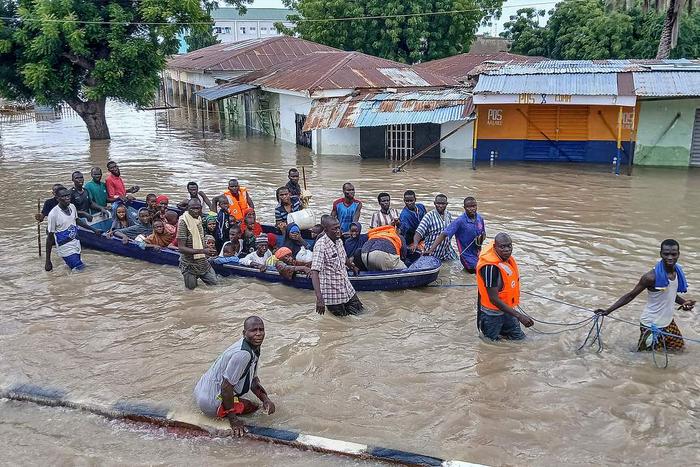
The Federal Government has placed Nigerian states on high flood alert in 2026, following the release of the 2026 Annual Flood Outlook (AFO), which identified thousands of communities across the country as vulnerable to severe flooding during the rainy season.
The warning was announced by the Minister of Water Resources and Sanitation, Joseph Utsev, during the public presentation of the Annual Flood Outlook by the Nigeria Hydrological Services Agency (NIHSA) at the State Banquet Hall of the Presidential Villa in Abuja.
According to the report, 266 local government areas (LGAs) across 33 states and the Federal Capital Territory (FCT) have been classified as high-risk flood zones.
The government said an estimated 14,118 communities are expected to face significant flood threats if preventive measures are not taken.
Speaking at the event, Utsev said, “Fourteen thousand, one hundred and eighteen communities in 266 local government areas in 33 States and the FCT fall within the high flood risk areas.”
He listed the affected states as Abia, Adamawa, Anambra, Bauchi, Bayelsa, Benue, Borno, Cross River, Delta, Ebonyi, Edo, Enugu, Gombe, Imo, Jigawa, Kaduna, Kano, Kebbi, Kogi, Kwara, Lagos, Nasarawa, Niger, Ogun, Ondo, Osun, Oyo, Plateau, Rivers, Sokoto, Taraba, Yobe, Zamfara, alongside the FCT.
FG Identifies High, Moderate and Low Flood Risk Areas
The 2026 Annual Flood Outlook also classified several parts of the country into moderate and low-risk categories.
According to the report, 405 LGAs spread across 35 states are expected to experience moderate flooding during the rainy season. The government noted that every state except Ekiti falls within the moderate flood-risk category.
For areas with lower exposure, NIHSA projected minimal flooding in 923 communities across 77 LGAs located in 24 states.
Utsev said, “Low Flood Risk: Incidences of minimal flood are expected in 923 communities in 77 LGAs in 24 States. The states are Adamawa, Anambra, Bauchi, Bayelsa, Benue, Borno, Cross River, Delta, Ebonyi, Edo, Jigawa, Kaduna, Kano, Kebbi, Kogi, Nasarawa, Niger, Ogun, Ondo, Osun, Oyo, Sokoto, Taraba, and Zamfara.”
Flooding has remained one of Nigeria’s most frequent natural disasters, particularly during the peak rainy months.
Heavy rainfall, overflowing rivers, blocked drainage systems and increasing urban development have contributed to recurring floods that damage homes, farmlands, roads and public infrastructure.
To improve preparedness, the Federal Government announced the introduction of a community-based flood forecasting system designed to provide location-specific warnings instead of broad state-level predictions.
The upgraded system uses hybrid artificial intelligence models to generate forecasts for individual communities, enabling authorities and residents to respond more quickly to emerging flood threats.
Tinubu Reaffirms Commitment to Disaster Preparedness
President Bola Tinubu reiterated his administration’s commitment to strengthening Nigeria’s emergency management system and improving disaster response across the country.
Represented by the Minister of Environment, Balarabe Lawal, the President said the government had reviewed existing challenges affecting emergency operations and was taking steps to improve coordination among relevant agencies.
According to Tinubu, efforts are underway to strengthen the capacity of ministries, departments and emergency management institutions to deliver faster and more effective rescue operations whenever disasters occur.
He also stressed the importance of sustainable development and proper planning, noting that improved communication between government agencies and the public would play a major role in reducing the impact of floods and other emergencies.
The President added that effective communication remains essential for collaboration, raising public awareness and ensuring timely action before and during emergencies.
Also Read: 271 Nigerians Evacuated from South Africa Arrive in Lagos as FG Continues Repatriation Effort
The 2026 Annual Flood Outlook was presented under the theme, “Smart Water Resources Management: Moving From Oil To A Water-Based Economy,” with ministers, government officials and stakeholders from Nigeria’s water resources sector in attendance.
With Nigerian states on high flood alert in 2026, authorities are urging state governments, emergency agencies and residents in vulnerable communities to remain vigilant, follow official advisories and take proactive measures to reduce the impact of potential flooding as the rainy season progresses.
