



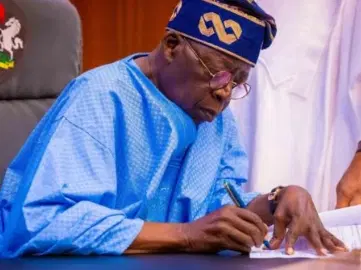
President Bola Tinubu is moving closer to securing constitutional approval for the establishment of state police in Nigeria after 28 State Houses of Assembly approved the proposed amendment.
The National Assembly is preparing to transmit the State Police Bill to the President for assent, following confirmation that the required number of state legislatures has supported the proposal.
According to the Clerk to the National Assembly, Kamoru Ogunlana, his office had received and verified approval reports from 28 state legislatures as of November 4, 2026.
The development exceeds the constitutional requirement of 24 states, representing two-thirds of Nigeria’s 36 State Houses of Assembly.
National Assembly Confirms Approval by 28 States
The proposed amendment, titled the Constitution of the Federal Republic of Nigeria, 1999 (Sixth Alteration) Bill, seeks to establish State Police Services and provide the legal framework for their operation.
Ogunlana explained that the bill was transmitted to all 36 State Houses of Assembly on September 16, 2026, for consideration and approval.
The state legislatures were initially given 30 days, ending October 15, to communicate their decisions to the National Assembly.
However, the Clerk said his office would continue receiving reports from state assemblies until the bill is formally transmitted for presidential assent.
He also explained that the National Assembly had verified the submitted votes and proceedings to confirm that they accurately represented the decisions of the respective legislatures.
According to Ogunlana, Section 9 of the Nigerian Constitution requires approval from at least two-thirds of the state assemblies for a constitutional amendment of this nature.
He further clarified that the Constitution does not expressly require a Third Reading for a Constitution Alteration Bill, unlike the procedure for ordinary legislation.
Full List of 28 States That Approved State Police
The 28 states reported to have approved the proposed establishment of state police are:
- Adamawa
- Delta
- Edo
- Kwara
- Nasarawa
- Ogun
- Osun
- Oyo
- Plateau
- Rivers
- Taraba
- Zamfara
- Imo
- Ekiti
- Kebbi
- Akwa Ibom
- Bayelsa
- Enugu
- Anambra
- Benue
- Cross River
- Abia
- Yobe
- Kaduna
- Lagos
- Kano
- Sokoto
- Ebonyi
Presidency Seeks Private Sector Support for State Police
Meanwhile, the Presidency has asked the Organised Private Sector (OPS) to develop a financing and implementation framework for the proposed state police system.
The initiative is being coordinated by a committee headed by the President’s Chief of Staff, Femi Gbajabiamila.
Speaking during a plenary session on security, stability and economic resilience at the 32nd Nigerian Economic Summit in Abuja, Gbajabiamila urged business leaders to support the reform.
He explained that insecurity affects businesses beyond the cost of private security. It also discourages investment, delays factory expansion, disrupts supply chains and threatens employment opportunities.
Gbajabiamila encouraged business leaders to engage governors and lawmakers, contribute expertise in institutional management and expenditure control, and identify security challenges affecting investment.
Mike Okiro Recommends Safeguards Against Abuse
Former Inspector-General of Police and former Police Service Commission chairman, Mike Okiro, has called for strong legal safeguards to prevent state governors from using state police for political or personal interests.
Okiro argued that state governments already provide considerable operational support to the Nigeria Police Force through patrol vehicles, communication equipment and security infrastructure.
He cited Lagos State’s security initiatives, including the Lagos State Security Trust Fund, surveillance systems and forensic facilities.
He also mentioned Enugu State’s Digital Surveillance Control Centre as an example of infrastructure that could support effective policing.
According to Okiro, state governments should be capable of funding their police formations. However, he suggested that the Federal Government could assist states facing difficulties with salaries and other financial obligations.
He also described security as essential to economic and social development, noting that investors are less likely to commit resources to unsafe environments.
Former IGP Proposes Four-Year Tenure for Police Commissioners
On the issue of political interference, Okiro recommended extending tenure protections for the Inspector-General of Police to state Commissioners of Police.
He noted that the Police Act Amendment 2024 provides a four-year tenure for the IGP, allowing the police chief to complete the term except in cases of misconduct or gross violation of the Constitution.
He proposed similar protection for state Commissioners of Police, suggesting that their removal should require approval by a two-thirds majority of the relevant State House of Assembly.
Under the proposed arrangement described by Okiro, the State Police Council would oversee policing policies, recruitment and training, while the Commissioner of Police would serve as its secretary for a single four-year term.
Also Read: Four Nigerian-Americans Win 2026 US Midterm Elections
He also warned against a situation in which governors exercise unrestricted control over state police formations, recalling concerns about political use of the police during the First Republic.
Okiro said the law should establish clear checks and balances to prevent governors from deploying officers for partisan, ethnic, religious, sectional or personal purposes.
He further highlighted proposed restrictions on unlawful directives, alongside state-level complaints units and national standards for recruitment, training, discipline, use of force, firearms and accountability.
State Police Proposal Moves Towards Presidential Assent
With 28 state legislatures having reportedly approved the amendment, the proposed state police system has crossed the constitutional approval threshold outlined by the National Assembly.
The bill must still complete the required formal process, including transmission to President Tinubu for assent, before the proposed system can become operational.
The reform is expected to introduce a decentralised policing structure in which state governments establish and fund their own police services alongside the existing Nigeria Police Force.
However, questions about funding, recruitment, training, accountability and protection against political interference remain important considerations as the proposal moves towards implementation.
