



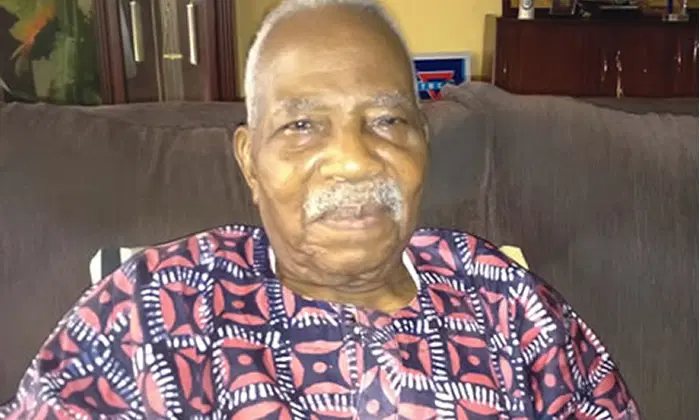
The leadership crisis within the pan-Yoruba socio-political organisation, Afenifere, has intensified following the death of its leader, Pa Reuben Fasoranti, with fresh disagreements emerging over succession and the future direction of the group.
Some members are reportedly considering the formation of a new organisation known as Afenifere Independent, while another faction is urging members to unite behind Oba Oladipo Olaitan.
However, members associated with the Fasoranti camp have resisted the move, insisting that the leadership question should not be settled before the late leader’s burial.
The disagreement has also exposed longstanding ideological and political divisions within Afenifere. Some chieftains believe the existing factions should be abandoned in favour of a fresh leadership structure capable of bringing the Yoruba group together.
A source quoted by Vanguard said discussions were ongoing among some elders to establish a new platform rather than continue with the competing camps.
The source also claimed that the Akure faction was preparing to nominate a former governor as Fasoranti’s successor, adding that it would not accept Oba Olaitan as the organisation’s leader.
Olaitan Camp Calls for Unity
Following Fasoranti’s death, the faction associated with Oba Oladipo Olaitan announced that it had consolidated its collective leadership under his stewardship.
The group described the move as a tribute to Fasoranti’s legacy and an effort to strengthen unity while protecting Yoruba socio-political interests.
In a statement, the faction’s National Publicity Secretary and Secretary-General, Prince Justice Faloye and Alade Rotimi-John, respectively, said Olaitan had demonstrated the leadership qualities needed to guide the organisation.
They described the late Fasoranti as a respected figure whose leadership was shaped by the ideals of Chief Obafemi Awolowo, Chief Adekunle Ajasin and Senator Abraham Adesanya.
The statement also praised his commitment to true federalism, fairness, justice and the development of the Yoruba people.
The faction urged political actors, members and younger generations to close ranks behind Olaitan, arguing that unity was essential to the survival and progress of the Yoruba nation.
It further described his traditional position as an advantage, saying his royal background would help him lead with restraint, wisdom and dignity.
However, the announcement reportedly angered some Afenifere chieftains, who questioned the decision to present Olaitan as the group’s leader without broader agreement.
Following the backlash, Oba Olaitan was said to have called a meeting on Thursday to address the growing disagreement.
Falae Rejects Succession Discussions Before Burial
The Chairman of Afenifere’s National Executive Committee, Oba Olu Falae, has distanced himself from the position taken by the Olaitan camp.
Speaking in Akure during the delivery of a condolence message to the late leader’s family, Falae described the succession discussion as premature.
He argued that Yoruba tradition does not support discussing a leader’s successor before the deceased has been buried.
According to him, Afenifere’s immediate responsibility should be to organise a befitting burial for Pa Reuben Fasoranti before considering who should take over the leadership.
His position has added to calls for restraint as the organisation navigates the uncertainty surrounding its future.
Adejumo Warns Against Forceful Takeover
Former Afenifere spokesperson Mogaji Gboyega Adejumo, who identifies with Afenifere Independent, has also criticised the attempt to establish Oba Olaitan as the group’s leader.
He argued that Afenifere has experienced ideological divisions since the political era of Chief Obafemi Awolowo.
According to Adejumo, Awolowo’s political philosophy was built around progressivism, egalitarianism, democratic socialism and the Yoruba value of Omoluabi.
He said Awolowo’s record in the former Western Region reflected his commitment to education, infrastructure, social development and ethical public service.
He cited projects and institutions such as Africa’s first television station, modern government facilities, the Western Nigeria Development Corporation, the Bodija estate and Ikeja Government Reserved Area as examples of that development philosophy.
Also Read: Real Warri Pikin Wins AFRIMMA Best Stand-Up Comedian Award
Adejumo argued that some political tendencies within Yorubaland had consistently opposed those ideals, contributing to divisions that have affected the region’s political history.
He also maintained that Awolowo never intended Afenifere to become an organisation focused exclusively on Yoruba interests.
According to him, the group was established as a platform for promoting progressive political ideas across Nigeria, rather than a Yoruba irredentist movement.
He said the name Afenifere was introduced by Chief Akinloye in 1951 to communicate the idea of a more abundant life to ordinary people.
Rejecting the proposed leadership arrangement, Adejumo warned that no faction should attempt to take control of the organisation without consensus.
He described any forceful takeover as unacceptable and said it could deepen the existing divisions.
Proposal for a Third Afenifere Faction
Adejumo also disclosed that he had received a call from respected Afenifere elder Dr Femi Okurounmu about plans to establish a third faction.
According to him, Okurounmu said he and some other elders believed the two existing camps had become too weakened to restore the organisation.
However, Adejumo said he rejected the proposal at the time, arguing that the group should avoid another split ahead of the forthcoming elections.
He suggested that discussions about a new leadership structure should take place after the elections, when members could consider how to rebuild Afenifere.
He also criticised the omission of late Afenifere leader Chief Ayo Adebanjo from the list of historical leaders mentioned in the Olaitan camp’s statement.
Adejumo argued that Adebanjo played a central role in preserving the organisation’s progressive ideals and should be recognised alongside Awolowo, Ajasin, Adesanya and Fasoranti.
He further claimed that there were fundamental differences between the Adebanjo and Fasoranti camps, making a united leadership under Olaitan difficult to achieve.
The former spokesperson also raised questions about the political relationships of the different factions, particularly their positions regarding the All Progressives Congress (APC) and the Social Democratic Party (SDP).
How Adebanjo Helped Fasoranti Become Afenifere Leader
Adejumo traced part of the current dispute to earlier leadership decisions within the organisation.
He recalled that when former Afenifere leader Chief Abraham Adesanya became seriously ill, he sought a successor and consulted senior members Olanihun Ajayi and Chief Ayo Adebanjo.
According to Adejumo, Adebanjo declined to take the position because he did not want his emergence to reinforce perceptions of an alleged Ijebu-dominated leadership.
Instead, he reportedly recommended Fasoranti, whom he considered capable of bringing different tendencies within the organisation together.
Adejumo said Fasoranti had been involved with Afenifere since 1953 and had served as Commissioner for Finance under former Ondo State Governor Chief Michael Ajasin.
He added that Fasoranti’s background as a retired school principal and businessman made him a suitable choice for the role.
According to his account, Afenifere later experienced renewed internal tensions from around 2008, with competing figures emerging and challenging the organisation’s leadership.
He said Adebanjo persuaded Fasoranti to remain in office when the latter considered stepping aside in 2015.
Later, Fasoranti reportedly appointed Adebanjo as acting leader, while Oba Olaitan became deputy leader.
Adejumo said Afenifere gained renewed visibility under Adebanjo, who became a prominent public voice for the organisation.
Afenifere’s Support for Peter Obi in 2023
The former spokesperson also discussed the organisation’s political position ahead of the 2023 presidential election.
He said Adebanjo began consulting members as early as 2021 on which candidate Afenifere should support.
According to Adejumo, Adebanjo’s argument was based on political equity, particularly the need to give the South-East an opportunity to produce Nigeria’s president.
He noted that the North and South-West had each produced presidents who served eight years, while the South-South had produced former President Goodluck Jonathan, whose tenure was shorter.
The discussions eventually led the faction to support the presidential candidacy of Peter Obi, who contested under the Labour Party.
Adejumo argued that Obi’s emergence significantly affected the 2023 election by attracting votes that could otherwise have strengthened the opposition candidate, Atiku Abubakar.
He suggested that this may have indirectly benefited President Bola Tinubu, whose victory was influenced by the division of opposition votes.
However, these comments reflect Adejumo’s assessment of the election rather than an established conclusion about how voters would have behaved under a different political scenario.
Uncertainty Over Afenifere’s Future
The latest disagreement has raised fresh questions about whether Afenifere can overcome its internal divisions and maintain its position as a major voice in Yoruba and Nigerian politics.
While the Olaitan camp is calling for unity behind its preferred leadership, other members insist that succession must follow established traditions and emerge through broader consultation.
The reported proposal to establish Afenifere Independent also suggests that some elders may be losing confidence in the existing factions.
For now, the organisation faces the challenge of managing its leadership transition while preserving the political philosophy and legacy associated with its founding figures.
Whether the factions can reach an agreement or move towards another split remains uncertain.
