



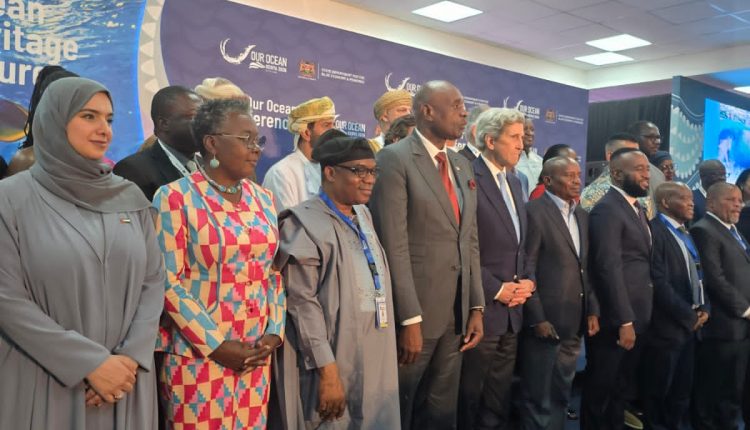
President Bola Tinubu has reiterated Nigeria’s commitment to harnessing the vast opportunities within the blue economy, unveiling plans to create five million new ocean-based jobs while strengthening regional cooperation to combat illegal fishing and maritime insecurity across Africa.
The President made the declaration during the opening ceremony of the 11th Our Ocean Conference held in Mombasa, Kenya, where he was represented by the Minister of State for Foreign Affairs, Ambassador Sola Enikanolaye.
Speaking on Nigeria’s maritime potential, Tinubu described the nation’s oceans and coastal resources as vital assets for economic growth, trade, food security, energy production, and climate resilience.
He stressed that the blue economy has become a major pillar of his administration’s development agenda.
“Our ocean resources are central to food security, trade, energy and the livelihood of Nigeria. For Nigeria, the ocean is not only a source of prosperity but also a pillar of sovereignty, security and climate resilience,” Tinubu stated.
The President noted that his administration elevated the blue economy to a national priority shortly after taking office in May 2023 by establishing the Federal Ministry of Marine and Blue Economy. According to him, the ministry was created to unlock the full value of Nigeria’s maritime assets while ensuring sustainable ocean governance.
With approximately 853 kilometres of coastline and a strategic position within the Gulf of Guinea, Nigeria remains one of Africa’s most important maritime nations. Tinubu said the country is committed to responsible ocean management in line with the United Nations Convention on the Law of the Sea and international maritime regulations.
As part of efforts to maximise the economic benefits of the sector, the President revealed that Nigeria has launched a comprehensive Blue Economy Action Plan focused on expanding fisheries, shipping, maritime tourism, and renewable energy industries.
“We have launched a blue economy action plan aimed at developing fisheries, shipping, maritime tourism and renewable energy.
This will enable us to achieve our pledge to create five million new jobs based on the ocean, prioritising youth and women, and ensuring that ocean industries uplift vulnerable coastal communities,” he said.
Tinubu emphasised that the initiative is expected to create significant employment opportunities, particularly for young people and women, while boosting economic activities in coastal regions across the country.
The President also called for stronger collaboration among African nations to tackle illegal, unreported, and unregulated fishing, which he described as a growing threat to food security and economic stability on the continent.
According to him, Africa’s maritime resources remain largely underutilised despite their enormous potential to contribute to national development and regional prosperity.
He urged global partners to support African countries through equitable financing arrangements and technology transfer initiatives that can accelerate the growth of ocean-based industries.
On environmental sustainability, Tinubu announced Nigeria’s commitment to expanding marine protected areas by 2030 and restoring 50 per cent of degraded mangrove ecosystems. He also pledged support for continental efforts aimed at reducing marine pollution and eliminating single-use plastics.
The President further highlighted the importance of maritime security in achieving economic progress, noting that Nigeria continues to play a leading role within the Yaoundé Architecture framework for maritime security in the Gulf of Guinea.
“Maritime security is inseparable from food security, trade facilitation and peace-building,” Tinubu said.
He added that investments in modern surveillance technology and improved naval capabilities have significantly reduced piracy incidents in the Gulf of Guinea, enhancing commercial shipping activities and strengthening confidence among maritime stakeholders.
Tinubu also advocated stronger partnerships involving governments, development finance institutions, private-sector investors, and civil society organisations to mobilise sustainable funding for ocean governance projects.
The President welcomed deeper cooperation between Nigeria, Kenya, and other African coastal nations, describing ocean diplomacy as an important pathway toward regional integration and shared prosperity.
He further stressed the need for greater participation of women and young people in maritime governance and decision-making processes, arguing that inclusive leadership is essential for unlocking the full economic potential of the blue economy.
Read Also: FG Launches N50m Support Fund for Cancer Patients
“Our ocean is our common heritage, and its future depends on the collective action we take today. We stand ready to collaborate, to lead, and to contribute to building a continent where maritime sovereignty is respected, security is guaranteed, and prosperity is shared,” Tinubu stated.
The renewed focus on the blue economy underscores Nigeria’s broader strategy to diversify its economy, create jobs, strengthen maritime security, and position the country as a leading force in sustainable ocean development across Africa.
