



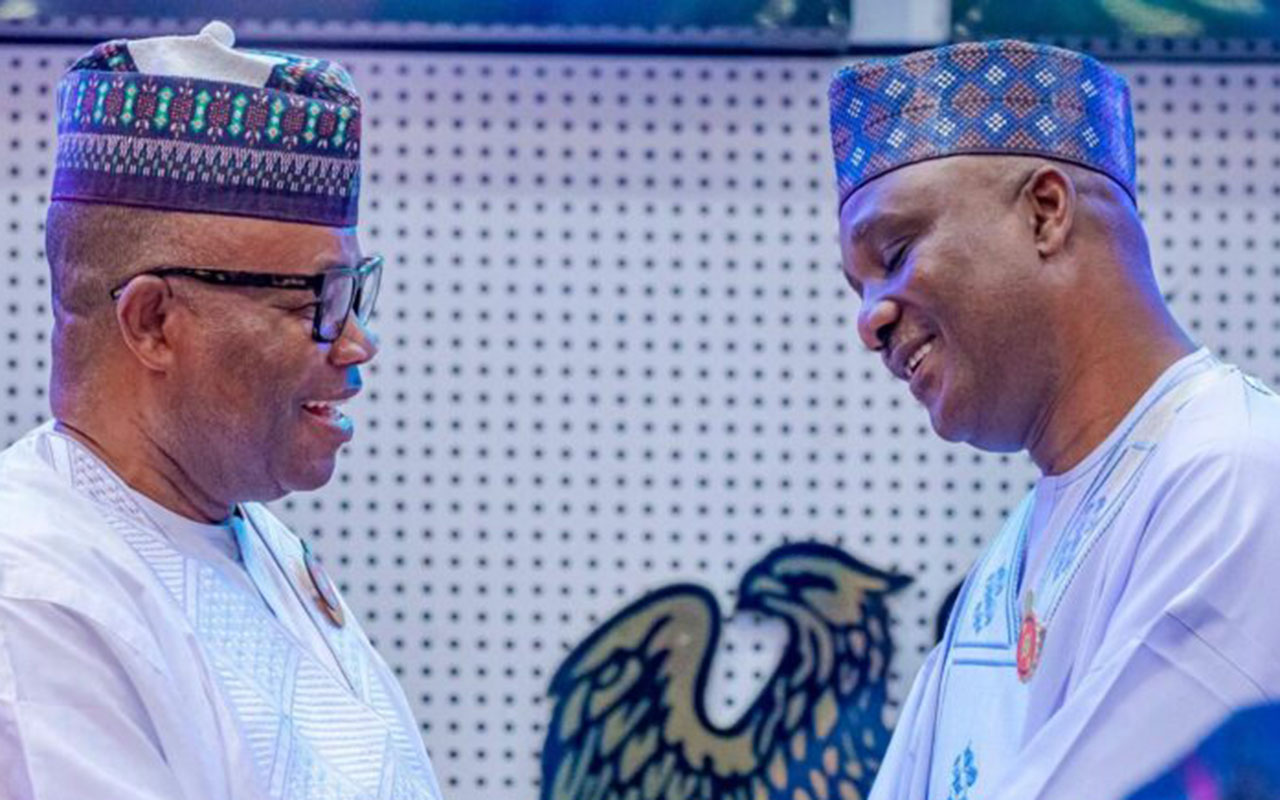
The Socio-Economic Rights and Accountability Project (SERAP) has given Senate President Godswill Akpabio and Speaker of the House of Representatives Tajudeen Abbas seven days to begin an investigation into alleged constituency funds diversion involving more than ₦6.3 billion or face legal action.
The civic organisation is urging the leadership of the National Assembly to refer the allegations contained in the Auditor-General of the Federation’s 2022 Annual Report to anti-corruption agencies for investigation and possible prosecution. SERAP also called for the recovery of any public funds found to have been diverted and their return to the national treasury.
The demand was contained in a letter dated June 27, 2026, and signed by SERAP’s Deputy Director, Kolawole Oluwadare. Details of the letter were released in a statement on Sunday.
According to SERAP, the Auditor-General’s report, published on September 9, 2025, identified several cases of financial irregularities across multiple federal Ministries, Departments and Agencies (MDAs), raising fresh concerns about the management of constituency project funds.
“We would be grateful if the recommended measures are taken within seven days of the receipt and/or publication of this letter. If we have not heard from you by then, SERAP shall take all appropriate legal actions to compel you and the National Assembly to comply with our request in the public interest,” the organisation stated.
SERAP Demands Investigation Into Alleged Misuse of Public Funds
SERAP called on the National Assembly leadership to refer the Auditor-General’s findings to anti-corruption agencies, including the Economic and Financial Crimes Commission (EFCC) and the Independent Corrupt Practices and Other Related Offences Commission (ICPC).
The organisation also requested the disclosure of the contractors and companies that allegedly received constituency project funds without executing approved projects. It further demanded that the shareholders and beneficial owners of the companies involved be made public.
According to SERAP, the Auditor-General identified cases involving payments into private bank accounts, contracts awarded without due process, payments for projects allegedly not executed, undocumented expenditures, inflated contract values, procurement violations and failures to properly account for public funds.
“The Auditor-General identified numerous cases of payments into private bank accounts, contracts awarded without due process, payments for contracts not executed or services not rendered, undocumented expenditures, inflated contracts, procurement irregularities and failures to account for public funds, recommending in each case that the funds be recovered and remitted to the treasury,” the organisation said.
Among the agencies mentioned in the report is the Environmental Health Registration Council of Nigeria (EHORECON), where over ₦22.9 million was allegedly paid into the personal bank accounts of some staff members from the Constituency Projects Fund Account.
According to SERAP, the report stated there was no evidence showing how the money was used or any explanation for why the payments were made into private accounts.
The report also questioned consultancy contracts worth more than ₦12 million awarded by EHORECON in 2021 for the design and supervision of modern abattoir projects in Kebbi, Jigawa and Abuja.
“The money was to produce bills of quantity, architectural design, structural design, mechanical design, and electrical designs for the contracts and supervision. But the items could not be found,” SERAP quoted from the report.
Auditor-General Report Lists Multiple Agencies
Beyond EHORECON, SERAP said the Auditor-General’s report identified several other agencies linked to questionable spending.
The Federal College of Animal Health and Production Technology, Vom, allegedly paid more than ₦279.7 million to contractors for youth and women empowerment programmes without proper documentation.
The report also alleged that another ₦279.7 million was released as mobilisation fees without supporting records, while contracts worth over ₦629.4 million were awarded without evidence of due process.
At the Federal Polytechnic, Ukana, the report allegedly identified more than ₦407 million paid as mobilisation without supporting documents, over ₦399 million awarded to unqualified contractors, contracts inflated by more than ₦192 million, over ₦279 million spent on projects that were not fully completed, ₦50 million paid for an unfinished borehole project and more than ₦83 million disbursed without the required approvals.
SERAP also alleged that the National Agency for the Prohibition of Trafficking in Persons (NAPTIP) awarded contracts worth more than ₦21.8 million irregularly, paid over ₦176.8 million for consultancy and logistics services without supporting documents and released more than ₦94 million for projects that were reportedly not executed.
The organisation further claimed that the National Institute of Legislative and Democratic Studies (NILDS) failed to submit audited financial statements covering the period from 2012 to 2022, did not remit more than ₦15 million in stamp duties and spent ₦1.6 million without approval from the Office of the Accountant-General of the Federation.
SERAP argued that corruption involving constituency project funds continues to deny many Nigerians access to basic infrastructure and essential public services.
Also Read: Lagos-Calabar Coastal Highway Faces New Restrictions as FG Bans Motorcycles and Tricycles
The organisation added that if the allegations are established, they could amount to violations of the 1999 Constitution, the Fiscal Responsibility Act 2007 and the Public Procurement Act 2007, all of which require transparency, accountability and due process in the management of public resources.
As of the time of filing this report, neither the Senate President nor the Speaker of the House of Representatives had publicly responded to SERAP’s demands.
